
Medically reviewed by Dr. David Biro, MD, PhD | Board-Certified Dermatologist | 30+ Years Experience | Last Updated: April 2026
Quick Answer
Masseter Botox is an injection of botulinum toxin into the masseter muscle on each side of the jaw. It is used for two reasons: to relieve teeth grinding (bruxism) and TMJ-related jaw tension, and to slim a square or wide-looking jawline by shrinking the muscle over time. Most patients receive 25 to 50 units per side. Bruxism relief begins in 2 to 3 weeks. Visible jawline slimming develops over 6 to 12 weeks. Effects last 3 to 4 months at first, then often longer with repeat treatment as the muscle adapts.
Masseter Botox is one of the fastest-growing injectable treatments in cosmetic and functional dermatology, and for good reason. A single treatment can simultaneously soften a square jawline and relieve the chronic jaw tension, headaches, and tooth wear caused by teeth grinding. For patients in Brooklyn, Bay Ridge, and Staten Island, it has become a particularly popular option because it solves two problems at once with a 15-minute appointment.
This guide explains how masseter Botox works, what dosing looks like, what to expect during and after treatment, and how to decide whether you are a good candidate.
What Is Masseter Botox?
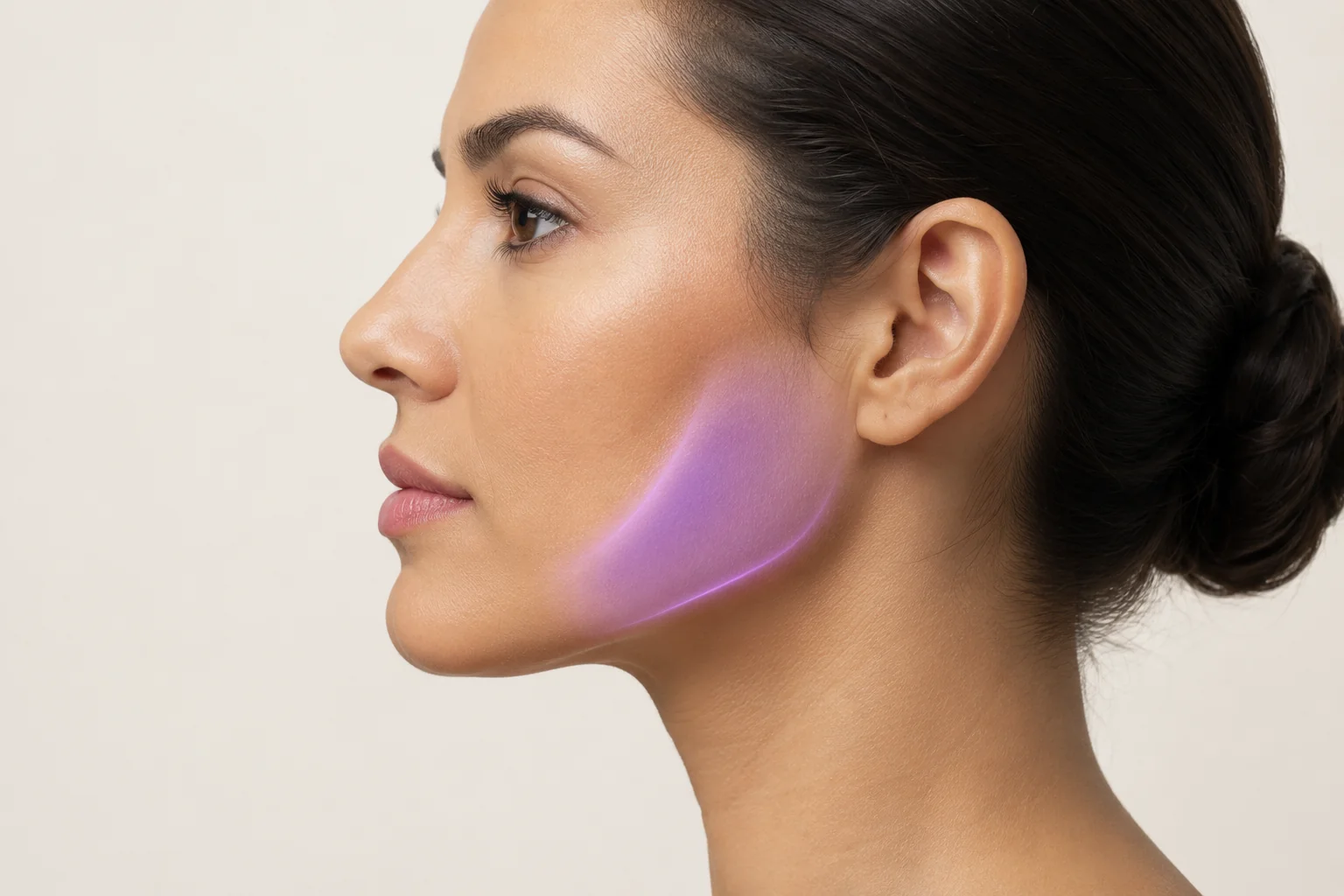
The masseter is one of the strongest muscles in the human body relative to its size. It runs along each side of your jaw, from your cheekbone down to the angle of your mandible, and it is the muscle you feel bulging when you clench your teeth. Its primary job is chewing, but it is also recruited heavily during stress, sleep grinding, and concentration.
Masseter Botox uses small injections of botulinum toxin (Botox, Dysport, Xeomin, or Jeuveau) placed directly into the muscle on each side. The toxin temporarily blocks the nerve signals that tell the muscle to contract. Within two to three weeks, the muscle begins to relax. With repeated treatments over several months, the muscle gradually shrinks because, like any muscle, it atrophies when it is not being worked.
The result depends on what the patient is trying to achieve. Some people get masseter Botox purely for medical reasons, hoping to stop nighttime grinding and the morning headaches that come with it. Others get it for aesthetic reasons, hoping to slim a wide or square jawline into a softer oval shape. Many patients want both outcomes, and a single treatment plan can deliver both.
The Two Reasons People Get Masseter Botox
Understanding why masseter Botox is so popular requires looking at the two distinct patient groups that benefit from it.
Bruxism, TMJ tension, and chronic jaw pain (medical use)
Bruxism, the involuntary grinding or clenching of teeth, affects an estimated 10 to 30 percent of adults at some point in their lives. It often happens during sleep without the patient being aware of it, and the warning signs typically come from somewhere else: morning jaw soreness, tension headaches that start at the temples, worn or chipped teeth, sensitivity in molars, or a partner complaining about audible grinding at night.
Masseter Botox addresses bruxism at its source by reducing the contraction force of the muscle that does the grinding. Patients typically report relief within two to three weeks, and the benefit often becomes more dramatic with repeated treatments because the underlying muscle bulk decreases. Many patients who have used custom night guards for years report that masseter Botox provides relief the night guard never did, because the night guard protects the teeth without addressing the underlying muscle hyperactivity.
TMJ disorders are a related but distinct condition involving the temporomandibular joint where the jaw meets the skull. While masseter Botox is not a cure for TMJ disorders, it can significantly reduce the muscular component of TMJ pain by relaxing the surrounding muscles and reducing joint loading. For patients whose TMJ symptoms are driven primarily by muscle tension rather than joint structural issues, masseter Botox is often a meaningful part of the treatment plan.
Jawline slimming and facial contouring (aesthetic use)
Some people are born with prominent masseter muscles that give the lower face a square or wide appearance. This is genetic in many cases, and it is more common in certain ethnic backgrounds. The shape can also develop over time in patients who clench or grind chronically, since the muscle hypertrophies (grows larger) just like a bicep does with curls.
For these patients, masseter Botox can produce a noticeable narrowing of the lower face by allowing the muscle to atrophy slightly. The change is subtle at first, becoming visible around six to eight weeks and often peaking at three months. The face takes on a softer, more oval contour without surgery, fat removal, or downtime.
This aesthetic benefit is one reason masseter Botox has become especially popular among patients who feel their face appears wider in photos than in person, or who feel their jawline looks heavier than they would like. Combined with strategic jawline filler in some cases, the result can be a dramatically refined lower-face contour.
Who tends to be a good candidate?
- Patients with chronic teeth grinding or clenching, especially nighttime
- Patients with morning jaw soreness or tension headaches
- Patients with hypertrophic (overdeveloped) masseter muscles
- Patients who want a softer, more oval lower-face contour
- Patients with TMJ symptoms driven primarily by muscle tension
- Patients seeking a non-surgical alternative to jaw reduction surgery
Masseter Botox Dosing: How Many Units Do You Need?
Dosing varies based on muscle size, treatment goals, and the specific neurotoxin product used. The numbers below refer to Botox brand units; equivalent dosing in Dysport runs roughly 2.5 to 3 times higher and Xeomin approximately matches Botox.
Mild to moderate masseter hypertrophy or bruxism: 20 to 25 units per side, totaling 40 to 50 units. This dosing is common for women with mild grinding or modest aesthetic concerns.
Moderate masseter hypertrophy or significant bruxism: 25 to 35 units per side, totaling 50 to 70 units. This is the most common dosing range we see in practice.
Severe masseter hypertrophy or heavy grinding: 40 to 50 units per side, totaling 80 to 100 units. This dosing is more common in male patients with prominent masseters or in patients with severe bruxism that has caused tooth damage.
For comparison, treating forehead lines, frown lines, and crow’s feet typically uses about 20 to 60 total units. Masseter treatment uses noticeably more units because the muscle is so much larger and stronger than the small expression muscles in the upper face.
Your provider will assess your masseter size by having you clench your teeth and palpating the muscle, then plan a dose that balances therapeutic effect with the risk of over-weakening (which can affect chewing). Conservative starting doses are often appropriate for first-time patients, with adjustments at follow-up if needed.
What to Expect: Treatment Day, Onset, and Duration
Masseter Botox appointments are quick and well-tolerated. Here is what the typical experience looks like.
Consultation and assessment. Your provider will examine your jaw at rest and clenched, ask about grinding history, headaches, and aesthetic goals, and recommend a dosing plan. Photos are typically taken for baseline comparison.
The injection. The injection itself takes about five minutes. The provider marks the muscle, cleans the skin, and injects three to four small aliquots per side using a fine-gauge needle. Most patients describe the discomfort as a brief pinch comparable to or milder than other Botox injection sites. Topical numbing is available but rarely needed.
The first week. No visible or functional change. Some patients notice mild tenderness for a day or two, similar to a workout soreness in the jaw.
Weeks 2 to 3. Bruxism patients typically begin reporting improvement here. Morning jaw soreness and tension headaches start to ease. The masseter feels less tight when you palpate it.
Weeks 6 to 12. Aesthetic slimming becomes visible. The lower face takes on a softer, more refined contour as the muscle gradually atrophies. Bruxism relief is typically at its peak.
Months 3 to 4. Effects are at their full strength. This is also when most patients schedule their follow-up.
Beyond month 4. The neurotoxin wears off and the muscle gradually regains function. With repeat treatments, many patients find that the duration of effect lengthens over time as the muscle remains less developed.
Side Effects, Risks, and Recovery
Masseter Botox has a strong safety profile when administered by an experienced injector who understands the regional anatomy. The most common side effects are mild and short-lived.
Common, expected side effects: Brief tenderness at injection sites, mild swelling for a few hours, and occasional small bruises. Some patients notice a feeling of jaw fatigue when chewing tough foods (like steak or hard bread) for the first one to three weeks. This resolves as the patient’s chewing pattern adapts.
Less common side effects: Asymmetric smile, particularly if the injection is placed too far forward or too superficial. This is uncommon with proper technique and typically resolves as the toxin wears off. A “sunken” appearance below the cheekbone with overly aggressive dosing in patients with thin facial soft tissue. Conservative starting doses help avoid this.
What to do after treatment: Avoid lying flat for four hours. Avoid massaging or rubbing the injection area for 24 hours. You can return to normal activities, including work, immediately. Light to moderate exercise can be resumed within 24 hours.
Patients with active skin infections in the treatment area, a history of allergy to botulinum toxin, or certain neuromuscular conditions like myasthenia gravis are not candidates for Botox treatment.
“The masseter is a deceptively complex injection site. The muscle is large and easy to find, but the surrounding anatomy includes the parotid gland, the facial nerve, and the risorius and zygomaticus muscles that control smile. Knowing where to place each aliquot and where not to is what separates a clean masseter Botox result from one that affects the smile or feels heavy. We treat masseter as a precision injection, not a quick add-on.”
Clinical team at kalon Dermatology
Cost of Masseter Botox in Brooklyn
Masseter Botox is typically priced per unit, in line with how other Botox treatments are billed. In the Brooklyn and broader New York metro area, per-unit pricing usually falls between $13 and $18.
Based on typical dosing ranges, total treatment cost works out to:
- 40 to 50 total units (mild dosing): $520 to $900
- 50 to 70 total units (moderate dosing): $650 to $1,260
- 80 to 100 total units (heavier dosing): $1,040 to $1,800
Treatments are typically repeated every three to four months at first, then often less frequently as the muscle adapts. Long-term, many patients find that they can space treatments to every five to six months while maintaining results.
During your consultation, our team will provide a specific estimate based on your masseter size and treatment goals.
Masseter Botox at kalon Dermatology in Brooklyn
At kalon Dermatology, masseter Botox is performed by board-certified dermatologists and licensed advanced injectors with specific training in lower-face anatomy and neurotoxin dosing.
Why patients choose us for masseter Botox:
- Dual-trained injectors. Our providers treat both bruxism and aesthetic concerns regularly. We understand how to dose for either goal or for both, depending on what you are trying to achieve.
- Honest dosing recommendations. We start conservative when appropriate. Heavier doses can always be added at follow-up; over-weakening cannot be undone other than waiting for the toxin to wear off.
- Comprehensive lower-face menu. Masseter Botox often pairs well with jawline filler for contouring or Sofwave for skin tightening in patients with mild laxity. We design integrated lower-face plans rather than treating each issue in isolation.
- Two convenient locations. We serve patients across Brooklyn, including Sheepshead Bay, Brighton Beach, Bay Ridge, and Midwood, as well as Staten Island’s North Shore.
Our Locations
Brooklyn (Sheepshead Bay)
2792 Ocean Ave, 2nd Floor, Brooklyn, NY 11229
Mon to Thu: 10:00 AM to 6:00 PM | Fri: 9:00 AM to 3:00 PM
Staten Island (West Brighton)
796 Castleton Ave, Staten Island, NY 10310
Mon: 10:00 AM to 7:00 PM | Fri: 9:00 AM to 5:00 PM
Frequently Asked Questions About Masseter Botox
How many units of Botox does masseter usually require?
Most patients receive 25 to 35 units of Botox per side (50 to 70 units total). Patients with larger masseters or heavy grinding may need 40 to 50 units per side. First-time patients often start at the lower end of the range with adjustments planned at the four-month follow-up.
How long until I see results from masseter Botox?
Bruxism relief begins in 2 to 3 weeks. Visible jawline slimming develops over 6 to 12 weeks as the muscle gradually atrophies. The full aesthetic effect is typically at its peak around three months.
How long does masseter Botox last?
The neurotoxin effect lasts 3 to 4 months on the first treatment. With repeat treatments, many patients find the duration extends to 5 to 6 months because the muscle remains less developed between sessions.
Will masseter Botox affect my smile or chewing?
When properly placed, no. The masseter muscle is one of multiple chewing muscles, so reducing its strength does not eliminate your ability to chew. Some patients notice mild jaw fatigue with very tough foods for one to three weeks. Smile is not affected unless the injection is misplaced into the nearby smile muscles, which is uncommon with experienced injectors.
Can I use masseter Botox along with a night guard?
Yes. Many patients continue to wear their night guard initially and may find they can use it less often as treatment takes effect. The two approaches address bruxism differently: night guards protect the teeth from the force, while masseter Botox reduces the force itself.
How is masseter Botox different from jawline filler?
Masseter Botox shrinks the muscle to soften a wide jawline. Jawline filler adds volume and structure to define a weak jawline. They are opposite tools that solve different problems. Some patients benefit from both, especially when masseter Botox softens a wide jaw and filler then adds chin or jawline definition.