

From the Blog
Best Acne Facials in Brooklyn: A Dermatologist Guide to Treatments That Actually Work
On This Page
Medically reviewed by Dr. David Biro, MD, PhD | Board-Certified Dermatologist | 30+ Years Experience | Last Updated: May 2026
Quick Answer
The most effective acne facials in a dermatology setting are salicylic acid peels, HydraFacial with active acne add-ons, PRP microneedling for active breakouts and post-acne scars, and customized chemical peels (mandelic, glycolic, TCA). At kalon Dermatology in Brooklyn and Staten Island, we choose the right option based on your acne type (whiteheads vs cystic vs hormonal vs scarring), skin tone, and tolerance, rather than a one-treatment-fits-all menu approach. A consultation determines the right protocol within the first visit.
Searching for the "best acne facial in Brooklyn" returns dozens of medical spas, day spas, and dermatology offices, all claiming to clear breakouts and prevent new ones. The truth is that the term "acne facial" covers a wide range of treatments with very different mechanisms, ingredients, and effectiveness. The best option for one person may be the wrong choice for another.
This guide explains which in-office acne treatments actually deliver results, who each is best suited for, and how to choose between them. If you have struggled with acne that does not respond to home skincare, drugstore products, or generic spa facials, the right dermatology-supervised treatment can make a real difference.
What Makes a Facial Actually Effective for Acne?
Most "acne facials" advertised at day spas focus on cleansing and extractions. While professional extraction of comedones (whiteheads and blackheads) does help in the short term, by itself it does not address the underlying causes of acne: excess oil production, clogged pores, bacterial overgrowth, and inflammation.
An effective acne treatment plan does at least three of these four things:
A dermatology-led acne facial protocol is built around these mechanisms, not just around what feels relaxing. That distinction is why facials performed in a dermatology office typically outperform standard spa facials for true acne improvement.
The Top In-Office Acne Treatments (Ranked by Use Case)
Different acne presentations call for different treatments. Below are the in-office options that work best for specific skin scenarios.
Salicylic acid peels (best for oily, congested, comedonal acne)
Salicylic acid is a beta-hydroxy acid (BHA) that is uniquely well-suited for acne because it is oil-soluble, allowing it to penetrate into pores and dissolve the sebum and dead skin that causes blackheads and whiteheads. Office-strength salicylic peels (typically 20 to 30 percent) are far more effective than the over-the-counter 0.5 to 2 percent formulations available at the drugstore.
A salicylic peel feels like a brief tingling sensation on the skin and takes 15 to 20 minutes total. There is minimal downtime, with some patients noticing mild flaking for two to three days. Most patients see noticeable improvement after a single treatment, with optimal results developing over a series of three to six sessions spaced two to four weeks apart.
HydraFacial with active acne add-ons (best for combination, mild-moderate acne)
HydraFacial is a multi-step treatment that combines exfoliation, deep pore cleansing, painless extractions, and the infusion of customized serums. For acne-prone patients, providers add booster serums containing salicylic acid, antibacterial agents, or anti-inflammatory complexes.
The strength of HydraFacial for acne is its gentleness combined with effectiveness. There is no downtime, redness resolves within hours, and the deep pore cleansing addresses both active comedones and the buildup that leads to future breakouts. It is a particularly good option for patients who want consistent monthly maintenance rather than aggressive single sessions.
Mandelic and glycolic acid peels (best for sensitive skin, melanin-rich skin, acne with hyperpigmentation)
Mandelic acid is a gentler alpha-hydroxy acid with a larger molecular size, which means slower penetration and lower irritation risk. This makes it especially well-suited for patients with darker skin tones (Fitzpatrick types IV-VI) who are more prone to post-inflammatory hyperpigmentation from aggressive treatments.
Glycolic acid peels, in contrast, penetrate more deeply and are better for patients with thicker, more resilient skin who can tolerate stronger exfoliation. Both can be combined with salicylic acid for combination skin presenting both congestion and pigmentation.
PRP microneedling (best for acne scars, post-acne texture, and adult acne with pigmentation)
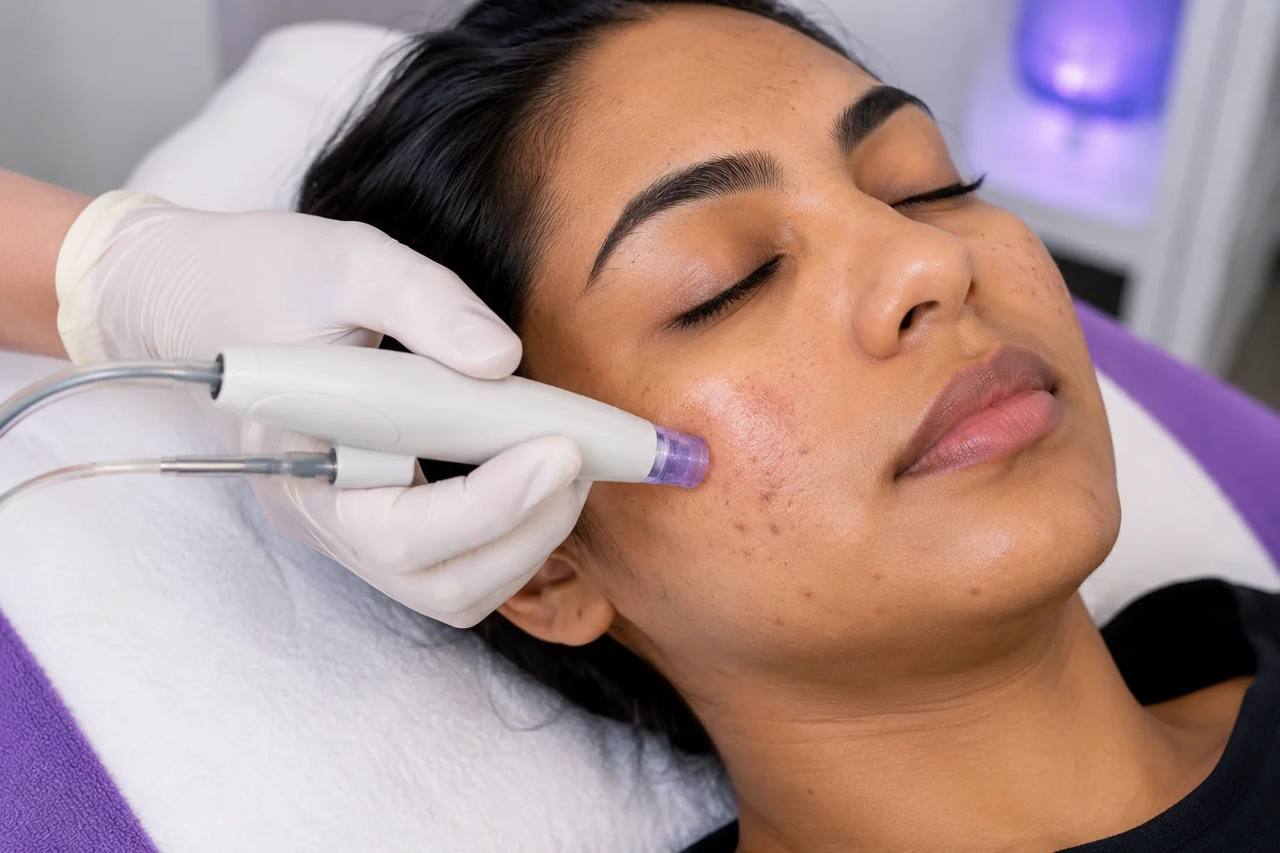
PRP microneedling uses a device with fine needles to create controlled micro-injuries in the skin, then applies platelet-rich plasma (PRP) drawn from your own blood. The micro-injuries trigger collagen production while the PRP delivers growth factors directly into the skin.
For active acne, PRP microneedling reduces inflammation and accelerates healing of existing breakouts. For post-acne scars (the boxcar, ice-pick, and rolling scars that remain after acne clears), it is one of the most effective non-laser treatments available. A series of three to six sessions spaced four to six weeks apart typically produces meaningful improvement in both acne activity and scar texture.
Blue light therapy (adjunct for inflammatory acne)
Blue light wavelengths (around 415 nm) target Cutibacterium acnes bacteria within the pores. While not strong enough as a standalone acne treatment for most patients, blue light is often added to other in-office protocols to enhance the antibacterial effect with no added downtime.
Choosing the Right Treatment for Your Acne Type
The "best" acne facial depends entirely on what kind of acne you have, your skin tone and sensitivity, and what you are trying to achieve.
Quick Match Guide
For severe inflammatory or cystic acne, in-office treatments alone are usually not enough. Patients in this category benefit most from a combined plan that includes medical management (topical retinoids, oral antibiotics, hormonal therapy, or isotretinoin in severe cases) alongside the right in-office treatments. Skipping the medical side and relying only on facials often produces frustrating partial results.
What to Avoid: Common Acne Facial Mistakes
Not every acne facial is helpful, and some can make the situation worse.
Aggressive extractions on inflamed lesions. Forcing extraction of red, inflamed pimples or cystic lesions can rupture the contents into the surrounding tissue, causing more inflammation and increasing the risk of scarring. Skilled providers know which lesions to extract and which to leave alone.
Heavy oil-based products on acne-prone skin. Some traditional spa facials finish with rich oils or comedogenic moisturizers that can clog pores and trigger breakouts in the days following the treatment.
Strong peels without skin priming. Jumping into aggressive chemical peels without first preparing the skin with appropriate home care can cause excessive irritation, peeling, and post-inflammatory hyperpigmentation, especially in patients with darker skin tones.
Ignoring the underlying cause. Monthly acne facials can help maintain clearer skin, but they do not address hormonal drivers, dietary triggers, or the need for prescription topical or oral therapy in moderate-to-severe acne. Pure facial-only protocols often plateau.
"The single most common pattern we see is patients who have spent years rotating through spa facials with modest, short-lived results. The treatments themselves are often fine, they are just not matched to the patient's actual acne type. A 20-minute consultation usually identifies what category of acne we are dealing with, and the right treatment plan often becomes obvious. The match between the patient and the treatment is what produces results, not the treatment itself in isolation."
Clinical team at kalon Dermatology
How Often Should You Get an Acne Facial?
For active acne management, the typical schedule is every two to four weeks during the initial improvement phase. Once acne is under good control, monthly maintenance is appropriate for most patients.
Patients on prescription acne medication usually combine that daily home routine with monthly in-office treatments. The medication does the heavy lifting on bacterial control and oil reduction, while the facial keeps pores clear and skin texture smooth.
For acne scars or post-acne pigmentation, treatment is usually a defined series (typically three to six sessions) rather than ongoing maintenance, with a re-evaluation at the end of the series to determine whether additional sessions are needed.
For more on treatment cadence, see our guide on how often you should get a facial based on your skin type and concerns.
Best Acne Facials at kalon Dermatology in Brooklyn and Staten Island
At kalon Dermatology, our acne treatment menu is built around a dermatology-led model: a board-certified dermatologist or licensed advanced provider evaluates your skin, identifies the type and drivers of your acne, and recommends the in-office treatment (or combination) most likely to produce results for you specifically.
Why patients choose kalon for acne treatment:
For deeper background on why facials work in a dermatology setting, see our companion guide on whether facials are good for acne.
Our Locations
Brooklyn (Sheepshead Bay) 2792 Ocean Ave, 2nd Floor, Brooklyn, NY 11229 Mon to Thu: 10:00 AM to 6:00 PM | Fri: 9:00 AM to 3:00 PM
Staten Island (Dongan Hills) 2131 Richmond Rd, Staten Island, NY 10306 Mon: 10:00 AM to 7:00 PM | Fri: 9:00 AM to 5:00 PM
Frequently Asked Questions About Acne Facials
What is the best facial for acne-prone skin?
For most patients, a salicylic acid peel series combined with monthly HydraFacials is a strong starting point because it addresses both pore clogging and bacterial buildup. The truly "best" option depends on your acne type, skin tone, and whether you also need to address scars or pigmentation. A consultation lets us match the right treatment to your specific skin.
How often should I get an acne facial?
During active acne improvement, every 2 to 4 weeks. Once your acne is under good control, monthly maintenance works well for most patients. Acne scar treatments like PRP microneedling are typically performed in a series of 3 to 6 sessions and then re-evaluated.
Can a facial make acne worse?
Yes, an inappropriate facial can. Aggressive extractions on inflamed lesions, comedogenic finishing products, and overly strong peels in unprepared skin can all worsen acne or cause post-inflammatory hyperpigmentation. Treatments performed by a dermatology team trained on your specific skin type minimize these risks.
Are HydraFacials good for acne?
Yes, when configured with acne-appropriate booster serums (typically salicylic acid or antibacterial complexes). Standard hydrating-focused HydraFacial protocols are less effective for acne. Ask whether your provider customizes the booster for active acne.
Will an acne facial help with acne scars?
Surface treatments like peels can improve mild post-inflammatory hyperpigmentation, but textural acne scars (boxcar, ice-pick, rolling) need treatments that work in the deeper layers of the skin. PRP microneedling is one of the most effective non-laser options. Severe scarring may also benefit from fractional laser resurfacing.
How much do acne facials cost in Brooklyn?
Pricing depends on the treatment. Salicylic peels typically run $150 to $300 per session. HydraFacial with acne boosters runs $200 to $400. PRP microneedling is more involved, typically $500 to $900 per session. Series and packages usually offer better per-session pricing. We provide detailed estimates at consultation.
About Author
Danny Bronshtein
Recent Post
Good to Know
Frequently Asked Questions
Keep Reading
Popular Articles
Expertise You Can Trust
Meet Our Expert Team
More than 75 years of combined dermatology and medical experience. Click any provider to read their background.
Disclaimer: This information is provided for educational purposes and is not a substitute for professional medical advice, diagnosis, or treatment. Please schedule a consultation with our team to discuss your individual needs.
Start Here
Reveal Your Best Self
Book your consultation today and learn how our experienced team can support your skin care goals.