
Medically reviewed by Dr. David Biro, MD, PhD | Board-Certified Dermatologist | 30+ Years Experience | Last Updated: May 2026
Quick Answer
Sofwave is best matched to patients with mild to moderate skin laxity, which usually means late 30s through mid 60s. In your 30s it works as preventative collagen maintenance. In your 40s it produces the most dramatic single-treatment results because skin still responds strongly to collagen stimulation. In your 50s it restores noticeable lift in patients who have not yet developed advanced sagging. In your 60s and beyond it can produce meaningful improvement, though patients with severe laxity often benefit more from combining Sofwave with surgical or surgical-adjacent options.
One of the most common questions we hear at consultations is some version of “Am I too young for Sofwave?” or “Am I too old for it to work?” The answer is rarely a hard cutoff. Sofwave works across a wide age range, but the goal of treatment, the realistic outcome, and the cadence of maintenance all shift meaningfully by decade.
This guide walks through how Sofwave fits into a skin-aging plan in your 30s, 40s, 50s, and 60s, and where the limits of what it can deliver actually start. If you are weighing whether to start now or wait, this should give you a clearer framework for that decision.
Why Age Matters for Sofwave Decision-Making
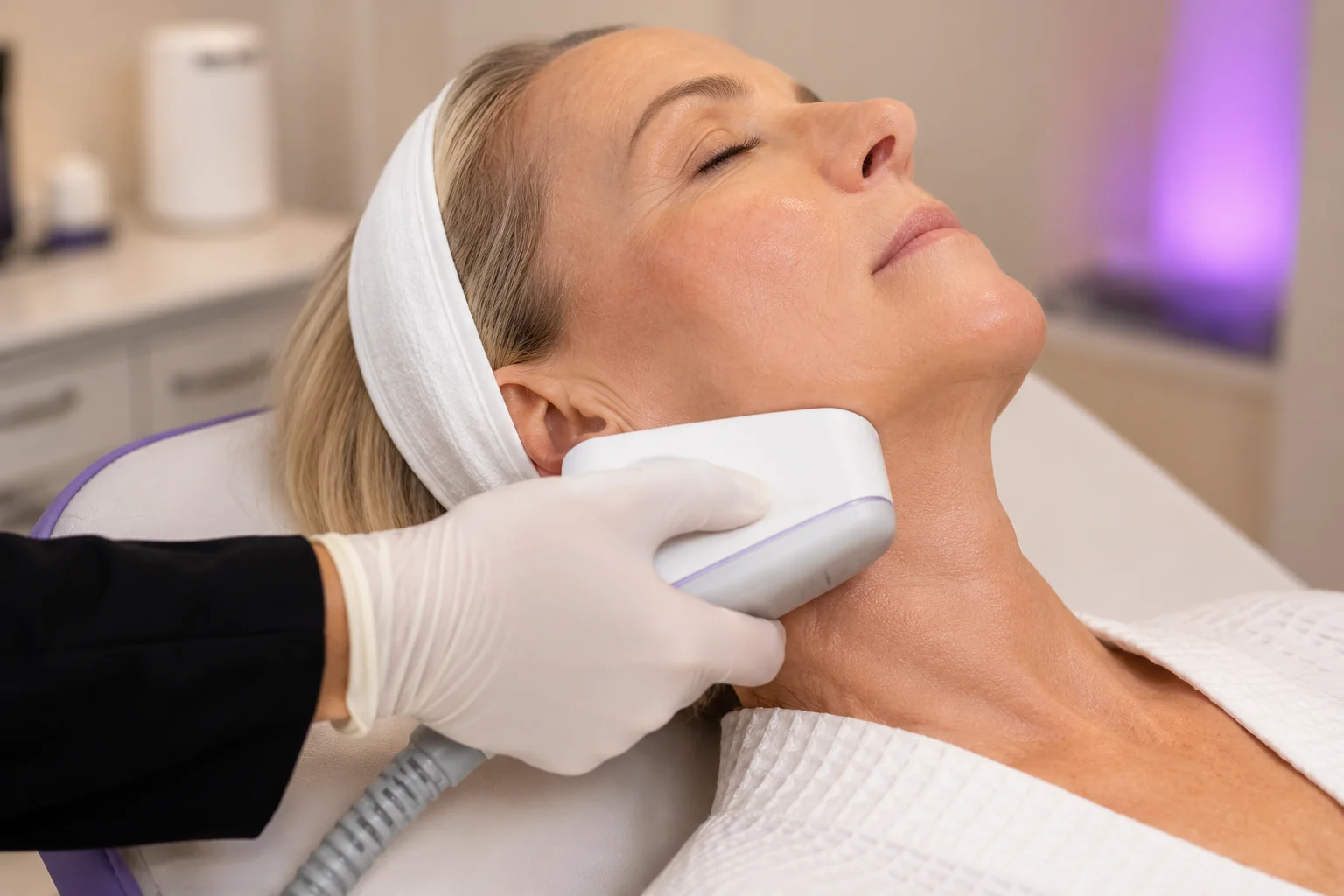
Sofwave uses focused ultrasound energy to heat the mid-dermis, the layer of skin where collagen and elastin live. The controlled heating triggers a wound-healing response that produces new collagen over the following three to six months. The treated skin lifts and tightens as the new collagen reorganizes the supportive scaffold beneath the surface.
What changes with age is your starting collagen reserve and your fibroblast responsiveness. Collagen production declines about 1 percent per year starting in your 20s, with a sharper drop around menopause. The same Sofwave treatment can produce a different magnitude of result depending on how much functional collagen-producing capacity your skin still has.
Three other variables also matter alongside age:
- Skin laxity grade. Mild laxity responds best. Severe sagging often exceeds what any non-surgical treatment can fully correct.
- Volume loss. Sagging caused primarily by lost facial fat and bone density is treated differently than sagging caused by loose skin alone.
- Lifestyle factors. Sun damage, smoking history, weight fluctuations, and overall skin health all influence how well the skin responds.
The decade-by-decade framework below assumes typical skin aging without significant outside factors. Your specific case may shift you up or down a decade in terms of what makes sense.
Sofwave in Your 30s: Prevention and Early Maintenance
The 30s are when subtle changes start: the first faint nasolabial fold deepening, slight loss of cheek fullness, the earliest hints of jowl development at the lower face. Most patients are years away from anything that would obviously read as “aging,” but the structural foundation has begun to shift.
Why patients in their 30s consider Sofwave: Some patients with strong family histories of early skin laxity want to start collagen-boosting treatments before laxity becomes visible. Others have noticed early changes after pregnancy, significant weight loss, or aggressive sun exposure during their 20s.
What Sofwave can deliver in your 30s: A single Sofwave treatment in your mid-30s often produces a subtle but real improvement in skin firmness and a thicker, more resilient feel to the dermis. The change is rarely dramatic enough to be obvious to others, but skin photographs better, holds up better against fatigue, and tends to age more gracefully over the following decade.
How often: Most 30s patients do well with a single treatment every 18 to 24 months, paired with consistent home skincare (SPF, retinoids, antioxidants).
What to expect realistically: Do not expect a visible “lift” in the same sense an older patient might. The benefit is more about preserving structural quality than reversing visible change.
Sofwave in Your 40s: The Sweet Spot
Your 40s are often the decade where Sofwave produces its most satisfying results. Visible laxity has begun to appear (early jowls, the start of neck sagging, looser skin at the jawline) but the skin still has strong fibroblast responsiveness and good collagen-producing capacity.
Why patients in their 40s consider Sofwave: The first noticeable changes in lower-face contour. Friends commenting that you look tired when you feel rested. Photographs starting to look “different” in ways you cannot quite articulate. Many patients in this group are considering injectables and Sofwave together as a comprehensive plan.
What Sofwave can deliver in your 40s: Visible lifting at the jawline and brow over three to six months. Smoother, firmer skin texture. A more refreshed appearance that often gets noticed without being identified as a treatment. For early jowls, Sofwave often produces enough improvement to delay or avoid more aggressive interventions.
How often: A single treatment lasts roughly 12 to 18 months in this age group. Many patients do annual or every-other-year sessions.
What pairs well: Botox for dynamic wrinkles in the upper face. Strategic fillers in the cheeks or under-eyes if volume loss is contributing. Skincare that includes a daily retinoid and SPF.
Sofwave in Your 50s: Restoration and Repair
The 50s bring the structural changes that often prompt patients to seriously consider treatment. Jowls become more pronounced, the neck shows sagging or banding, the brow descends, and the lower face starts to lose definition. For most women, perimenopause and menopause accelerate the process due to estrogen-related changes in skin and bone.
Why patients in their 50s consider Sofwave: A real desire to look refreshed, not “done.” Many patients in this group are explicitly avoiding surgical facelift but want meaningful improvement. Others are using Sofwave to extend the results of a previous lift or to address specific zones the previous lift did not target.
What Sofwave can deliver in your 50s: Real, visible lifting in the lower face and neck. Improvement in turkey-neck appearance, jowl softening, and a more defined jawline. The improvement is meaningful, though not equivalent to surgical correction in patients with significant laxity.
How often: Annual or every 12 to 18 months for sustained results. Some patients add a second treatment six months after the first to compound the collagen-building effect.
What pairs well: Sofwave often pairs with volume restoration in the cheeks and temples (using either HA fillers or Sculptra) and with Botox for the upper face. The combination addresses the three drivers of facial aging: loose skin, lost volume, and dynamic wrinkles.
Sofwave in Your 60s and Beyond: Realistic Expectations Matter
Patients in their 60s and 70s can absolutely benefit from Sofwave, but the conversation about realistic expectations becomes more important. The amount of laxity, the quality of the remaining collagen, and the underlying bone and fat structure all influence what is achievable.
Where Sofwave still works well: Patients with mild to moderate laxity, those who want maintenance after a previous facelift, those who are not surgical candidates due to medical history, or those who want subtle improvement without downtime.
Where Sofwave alone may not be enough: Patients with significant excess skin, deep jowling, advanced neck banding, or substantial volume loss often see meaningful but not transformative results. For this group, Sofwave can still play a role as part of a broader plan that may include volume restoration, surgical consultation, or both.
For more on cost expectations across non-surgical options at this stage, see our guide on non-surgical facelift cost.
Sofwave by Decade: Quick Reference
| Age | Primary goal | Realistic outcome | Cadence |
|---|---|---|---|
| 30s | Prevention | Subtle skin firming | Every 18 to 24 months |
| 40s | Early correction | Visible jawline + brow lift | Every 12 to 18 months |
| 50s | Restoration | Meaningful lift, refined jaw + neck | Annual |
| 60s+ | Maintenance or part of larger plan | Improvement varies with laxity grade | Annual or per individual plan |
When Sofwave Is Not the Right Answer
Sofwave is one tool in a broader skin-aging menu, and there are scenarios where another option is a better fit.
Severe skin laxity. Patients with substantial excess skin, particularly when there is enough loose tissue to lift between thumb and finger, often see better results from a surgical facelift or neck lift. Sofwave can still play a supportive role, but it should not be sold as the equivalent of a lift.
Primary problem is volume loss. If your face looks “deflated” rather than “drooping,” the right starting point is often filler-based volume restoration rather than skin tightening. Skin tightening on a face that needs volume can sometimes produce a more drawn or hollow appearance.
Active inflammatory skin conditions. Active acne, eczema flares, rosacea flares, or skin infections in the treatment area need to be controlled before Sofwave.
Pregnancy and breastfeeding. Sofwave is typically deferred until after weaning.
For comparison with the other major non-surgical skin-tightening platform, see our guide on Sofwave vs Ultherapy.
“The decade conversation matters more than the technology conversation. Sofwave is the same device whether you are 32 or 62. What changes is what we are realistically asking it to do. A 32-year-old wants to bank collagen for the next decade. A 62-year-old wants to look noticeably refreshed without surgery. Both are reasonable goals, but the second one requires a more honest conversation about what’s possible and where the limits actually are.”
Clinical team at kalon Dermatology
Sofwave at kalon Dermatology in Brooklyn
At kalon Dermatology, Sofwave is performed by board-certified dermatologists and trained advanced providers who have specific experience with the platform. We treat patients across a wide age range and tailor the protocol (number of passes, areas treated, follow-up cadence) to your individual goals.
Why patients across decades choose us for Sofwave:
- Honest age-and-laxity assessment. We tell you what Sofwave can realistically deliver for your specific anatomy and goal. If a different approach is a better fit, we will recommend it.
- Comfort-focused protocol. Medical-grade numbing cream is applied before treatment to make the experience more tolerable than older ultrasound platforms.
- Integrated treatment planning. Sofwave often produces the best result when paired with strategic volume restoration, Botox, or skincare adjustments. We design the full plan rather than treating Sofwave as an isolated procedure.
- Two convenient locations. We serve Brooklyn (Sheepshead Bay, Brighton Beach, Bay Ridge, Midwood) and Staten Island’s North Shore community.
Our Locations
Brooklyn (Sheepshead Bay)
2792 Ocean Ave, 2nd Floor, Brooklyn, NY 11229
Mon to Thu: 10:00 AM to 6:00 PM | Fri: 9:00 AM to 3:00 PM
Staten Island (West Brighton)
796 Castleton Ave, Staten Island, NY 10310
Mon: 10:00 AM to 7:00 PM | Fri: 9:00 AM to 5:00 PM
Frequently Asked Questions About Sofwave by Age
What is the best age to start Sofwave?
Most patients see the most satisfying single-treatment results in their late 30s through 50s, when collagen is still actively producible and laxity is mild to moderate. Patients in their 30s benefit from a preventative single session every 18 to 24 months. Patients in their 60s and beyond can still benefit, though realistic expectations matter more.
Is Sofwave too aggressive for someone in their 30s?
No. Sofwave is well-tolerated across age groups. The key in your 30s is calibrating expectations: the goal is preserving and gently boosting collagen rather than reversing visible aging that has not yet developed.
Will Sofwave work in my 70s?
It can, depending on the laxity grade. Patients with mild to moderate laxity in their 70s often see worthwhile improvement, especially when Sofwave is paired with volume restoration. Patients with significant excess skin may benefit more from surgical consultation.
How is Sofwave different from a surgical facelift?
A surgical facelift physically lifts and removes excess skin under anesthesia, with a recovery period of one to four weeks and dramatic but invasive results. Sofwave stimulates new collagen production with no incisions and no downtime, producing meaningful improvement that builds gradually over months. The two address different patient profiles and goals.
How long do Sofwave results last?
Single-treatment results typically last 12 to 18 months in patients in their 40s, with longer-lasting results in younger patients and shorter duration in patients with more advanced laxity. Annual maintenance is the most common cadence at kalon.
Does Sofwave hurt?
Most patients describe the sensation as warmth or brief discomfort during the treatment. Medical-grade numbing cream applied beforehand significantly reduces discomfort. The treatment takes 30 to 45 minutes for the lower face and neck.